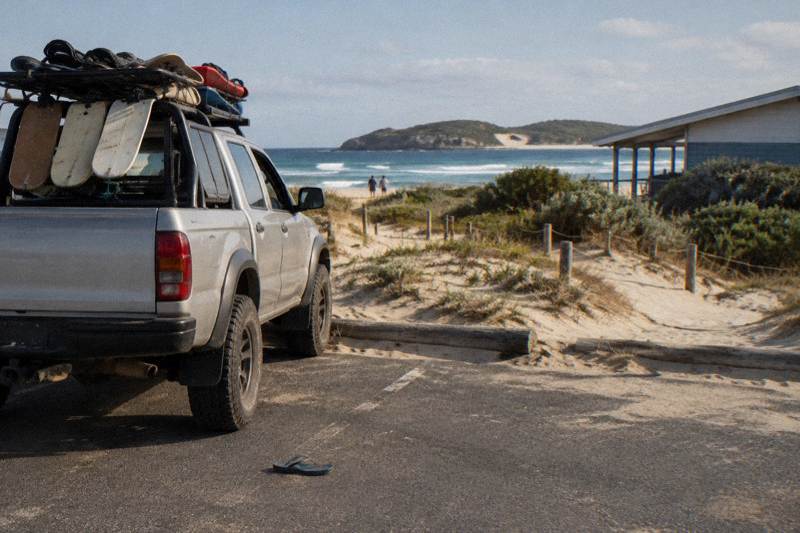
What Kind Of Board Is Used For Sandboarding In Port Stephens?
The boards used for sandboarding on the Stockton Bight dunes: sit-down boards, beginner and pro stand-up boards, tandem options, and which Port Stephens tour provides which.
Sandboarding on the Stockton Bight dunes at Port Stephens is not a one-board sport. The tours that run daily out of Anna Bay supply three distinct types of board: a sit-down board that anyone can use within minutes, a stand-up board that behaves like a snowboard cousin, and tandem setups that let a child or a cautious adult share a board with a guide or a partner. Which one you ride depends less on preference and more on which operator you book, because only one of the three sandboarding listings on these dunes carries all three types. If the stand-up board is the one that tempts you, our full comparison of sandboarding and snowboarding explains which skills carry over and which dune runs actually allow it.
That distinction matters more than most first-time visitors expect. A traveller who pictures themselves carving down a dune on two feet, then books the wrong session, will spend the afternoon seated on a plank instead. This article breaks down each board type, explains how the boards actually behave on sand, and matches every board to the Port Stephens listing that provides it, with prices and review counts.
What Kind Of Board Is Used For Sandboarding?
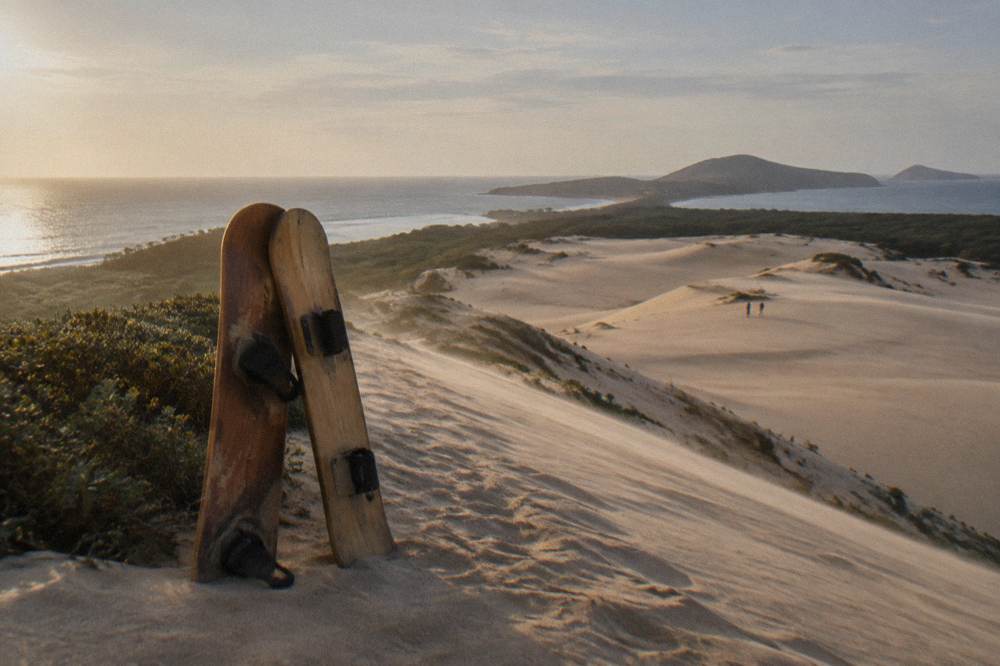
The board used for sandboarding at Port Stephens is a full-length laminate board with a slick waxed base, supplied in three formats: a sit-down board ridden like a toboggan, a stand-up board with optional foot bindings ridden like a snowboard, and tandem boards that carry two riders. Every sandboarding tour on the Stockton Bight dunes includes board hire, a roughly 10 minute 4WD transfer to the dunes and on-site instruction in the listed price. Since board hire is bundled into the tour price, many visitors wonder what else costs money, and our full breakdown of Stockton Sand Dunes access fees explains exactly what is free and what is not.
The sit-down board is the default across the dune tours and the format almost every beginner starts on. You sit or lie on the board near its tail, lift the nose with your hands, lean back, and let gravity do the rest. There is no balance to learn, no stance to master and no fall that involves much distance between you and the sand. It is the reason a sandboarding session works for children as young as three on some listings and for grandparents who have not stood on anything with a waxed base in fifty years.
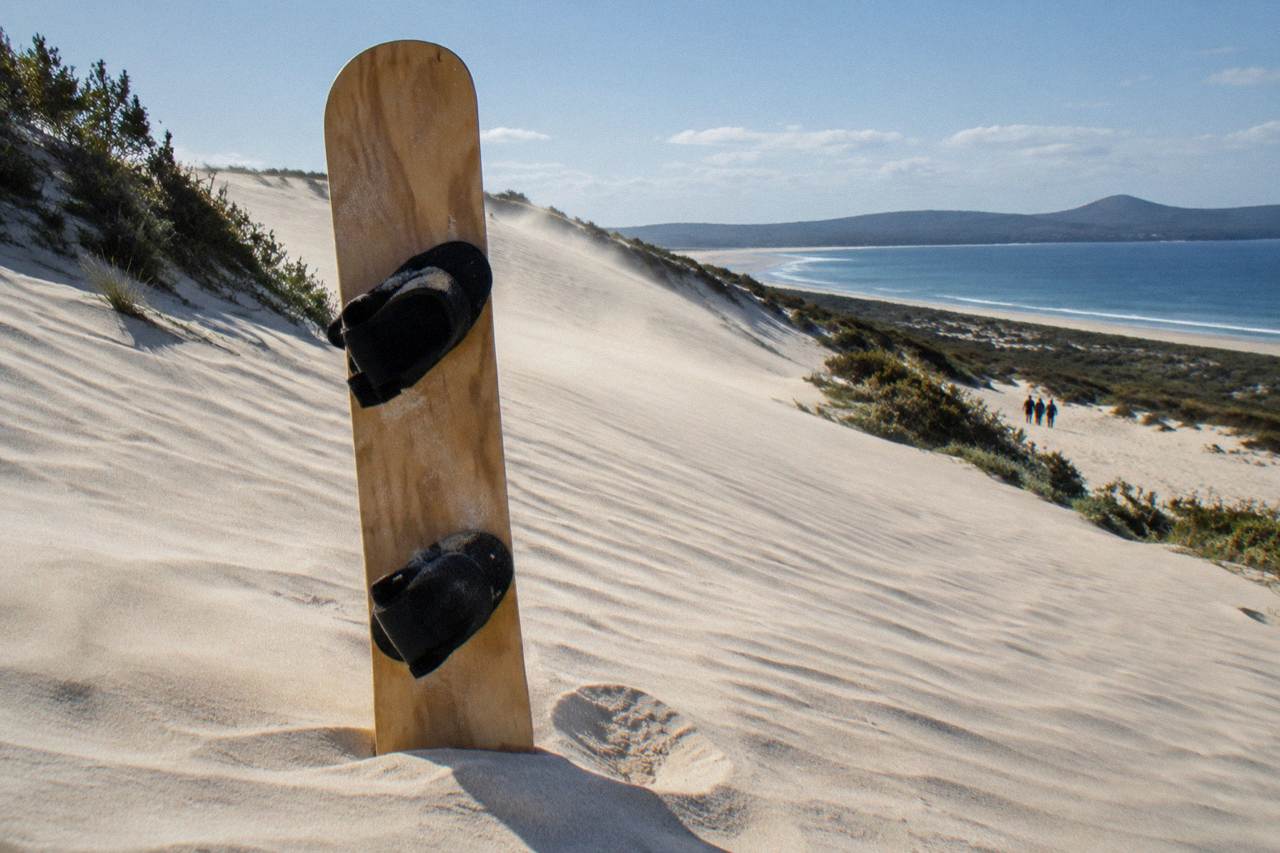
The stand-up board is a different animal. It looks like a snowboard, and on the only Port Stephens listing that carries it, it comes with and without foot bindings, so riders can choose a strapped-in snowboard stance or a looser, skate-style platform. The operator, Sand Dune Safaris, describes stand-up sand surfing as its own discipline on the dune, with tandem options that let two people share one board on the way down. The third operator format, Port Stephens 4WD Tours, supplies sit-down boards only and states plainly on its listing that stand-up boarding is not part of its session.
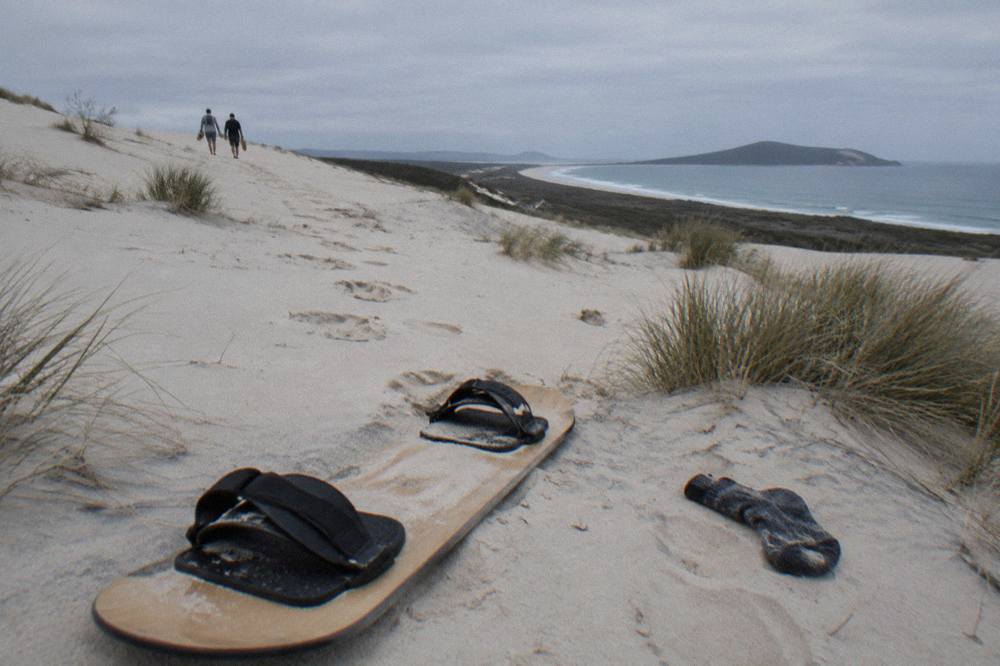
None of this equipment is something you bring. The boards are heavy, waxed and maintained by the operators, and the walk from the Anna Bay car parks to the riding dunes is long enough that carrying your own gear is impractical anyway. The 4WD transfer that every listing includes exists partly for this reason: the boards, the riders and the shade structures all travel to the riding area together. If you want the full picture of how these sessions work end to end, the sandboarding in Port Stephens guide covers meeting points, durations and what a session actually looks like hour by hour.
The Sit-Down Board: The Beginner Default At Anna Bay
The sit-down board is a flat-bottomed board with a curled nose, ridden seated or lying down like a toboggan, and it is the only format all three Port Stephens sandboarding operators supply. It needs no balance, no lessons and no particular fitness, which is why listings describe it as suitable for all ages and abilities. Most riders on the dunes are on one of these boards.
The mechanics are simple enough to explain in one sentence: sit near the tail, lift the nose, lean back and slide. Speed is controlled by how far you drag your feet and how steep a face you launch from, and the dunes around Anna Bay offer a natural progression from gentle beginner slopes to steeper faces. The operator's page for Sand Dune Safaris describes dunes of varying sizes including beginner slopes and a steep challenge slope, so a group can share one session while each person picks a hill matched to their nerve.
What surprises many first-timers is how fast a waxed board runs on dry sand. The base is coated in a paraffin-style wax, the same principle as a snowboard base, and on a warm afternoon with dry surface sand the board accelerates quickly enough that the first run is usually slower than everyone expects and the second run is faster than they wanted. Riders who want a slower experience can simply choose a shorter slope, since the dune field offers faces of many sizes within the riding area.
The sit-down format is also the most social. Two people can walk up together, slide down side by side, and compare notes at the bottom, and nobody in the group is excluded by ability. The listings reflect this: children ride sit-down boards, and the Sand Dune Safaris listing notes children 3 and under are free. For families weighing up whether the activity suits mixed ages, the honest answer is that the sit-down board is the most inclusive ride on the Stockton Bight dunes, and the one every operator can guarantee.
If a sit-down session is what you are after, the choice between the three listings comes down to price, meeting point and review pool rather than equipment. The 4WD Tours R Us listing, from $29.84 per person with a 4.5 rating across 574 reviews, is the most reviewed sandboarding session on the dunes, and NSW National Parks lists the operator as a licensed Worimi tour operator with a Parks Eco Pass. Check availability on the live listing to see current session times before you commit to a morning.
Stand-Up Boards And Where To Find Them In Port Stephens
Stand-up sandboarding uses a snowboard-shaped board with a waxed base, offered with or without foot bindings, and in Port Stephens it exists on only one listing: the Sand Dune Safaris session at Anna Bay, from $27.76 per person. The operator states it is the only company in Port Stephens offering both sit-down and stand-up styles, including tandem stand-up options.
Riding a stand-up board on sand is closer to snowboarding than most people guess, with one large difference: there is no lift and no corduroy, so every run starts with a climb up the dune face on foot, board under one arm. The descent is shorter than a snowfield run, but the sand is forgiving in a way packed snow is not, and falls cost nothing but a shake of the trousers. The operator frames the learning curve as shorter than snowboarding because the landings are soft and the slopes come in graduated sizes, an operator claim rather than a measured fact, but one consistent with how the sessions are structured.
The bindings question matters more on sand than on snow. Strapped-in bindings give snowboarders a familiar stance and real edge control, but they also mean your feet stay attached to the board through a fall, which beginners sometimes find worse than the fall itself. The binding-free stand-up option lets riders step off at the first wobble, which is why many instructors on dune fields start new stand-up riders without bindings and add them once balance is proven. The Sand Dune Safaris listing carries both formats, so the choice is the rider's, made on the dune rather than at the booking stage.
The listing behind this session is the cheapest sandboarding product on the dunes at from $27.76 per person, with a 4.7 rating across 212 reviews and free cancellation. It meets at the Sand Dune Safaris ticket booth in the Anna Bay Lower Car Park, runs unlimited time on the dunes, and includes the 4WD transfer, board hire and instruction. For a rider whose heart is set on standing up, this is the listing that makes that possible; the other two sandboarding sessions on these dunes supply sit-down boards only.
Tandem Boards And Family Options On The Stockton Dunes
Tandem sandboarding lets two riders share one board, either a child in front of an adult on a sit-down board or two riders on the stand-up tandem format the Sand Dune Safaris operator describes. Its purpose is confidence: a nervous child or a first-timer gets the sensation of the ride while an adult handles the launch. Only the listing that carries both board styles advertises tandem options.
The tandem sit-down arrangement is the simplest version: the smaller rider sits forward, the heavier rider sits behind and controls the nose and the speed. It is the dune-field equivalent of a toboggan with a second passenger, and it converts a hesitant four-year-old into a repeat customer within two runs. Because the adult absorbs the launch and the steering, the child experiences the slide without any of the decisions, which is why operators on family-heavy sessions use it constantly through school holidays.
The stand-up tandem is the more specialist item. The operator's page lists tandem stand-up options among its formats, which in practice means a shared stance on a longer board, something experienced riders treat as a novelty and instructors use to demonstrate stance and weight distribution. It is not a beginner tool the way the sit-down tandem is; it exists because the operator carries the full range of boards and can offer it, not because most sessions involve one.
Families comparing listings should weigh the free-child policies alongside the board range. The Sand Dune Safaris listing has children 3 and under free; the other two sandboarding listings publish their child pricing on their own pages. Session length is the other lever: all three listings run unlimited time within operating hours, but the Port Stephens 4WD Tours listing caps its final 3:30pm session near one hour, so families arriving late in the day get less dune for the same money. Arrive earlier and the unlimited format rewards you.
Which Port Stephens Listing Offers Which Board?
All three Port Stephens sandboarding listings supply sit-down boards with hire, transfer and instruction included. Only Sand Dune Safaris adds stand-up boards, binding-free boards and tandem options. The table below matches each listing's board range to its price, rating and review count, all taken from the live listings. If you're weighing up which listing offers the best deal, our guide to sandboarding prices in Port Stephens compares what each operator charges and what you get for it.
| Listing | Sit-down board | Stand-up board | Tandem options | From price (USD) | Rating and reviews |
|---|---|---|---|---|---|
| Sand Dune Safaris unlimited sandboarding | Yes | Yes, with and without bindings | Yes, sit-down and stand-up | $27.76 per person | 4.7 from 212 reviews |
| 4WD Tours R Us unlimited sandboarding | Yes | Not offered | Not advertised | $29.84 per person | 4.5 from 574 reviews |
| Port Stephens 4WD Tours unlimited sandboarding | Yes, sit-down only | Not offered | Not advertised | $31.80 per person | 4.4 from 139 reviews |
The price spread across the three listings is narrow, from $27.76 to $31.80 per person, so the board range is a better decision axis than cost. A group of sit-down riders can pick on review pool and meeting point: 4WD Tours R Us meets at 80 Gan Gan Road and carries the deepest review pool at 574, while Port Stephens 4WD Tours meets at the Anna Bay Lower Car Park like Sand Dune Safaris. A rider who wants to stand up has exactly one option, and conveniently it is also the cheapest.
For the sit-down majority, the 4WD Tours R Us session is the workhorse choice: family-owned since February 2015, licensed by NSW National Parks as a Worimi tour operator, and from $29.84 per person with free cancellation. Sessions typically run 1 to 1.5 hours of riding with unlimited time within operating hours. Check availability on the operator's live listing to compare morning and afternoon slots, since the dunes are cooler and the sand firmer before midday.
One caution belongs here because it affects board choice on the day: the operator of the sit-down-only session asks that riders not attempt stand-up riding on its boards, and the boards themselves are built for seated use. Attempting a stand-up run on a sit-down board is the classic way first-timers bend equipment and hurt a wrist, so if standing up is the goal, book the listing that supplies the right board rather than improvising with the wrong one.
How Sand Boards Differ From Snowboards
A sandboard looks like a snowboard but is built differently: its base uses a harder laminate waxed for dry sand rather than a polyethylene base waxed for snow, bindings are optional rather than standard, and there is no lift, so every run is earned by walking up. On sand the board runs on a thin cushion of rolling grains rather than a sliding film of meltwater.
The physics difference is the interesting part. A snowboard glides on a microscopic layer of water created by pressure and friction against the base; a sandboard glides on rolling grains, which behave like millions of tiny ball bearings under the waxed base. That is why sand boards perform best on dry, warm sand and why damp sand after rain feels sluggish: wet grains stick together instead of rolling. It is also why operators wax their boards constantly through the day, and why a freshly waxed board at 10am runs noticeably faster than the same board at 2pm.
For the rider, the practical differences are mostly about the climb and the descent length. Snowboarding spends most of its day on lifts; sandboarding spends it walking. The Stockton Bight dunes are the largest moving coastal sand mass in the southern hemisphere, and the riding areas within them offer short, steep runs rather than long traverses, which suits beginners. Riders coming from snowsports usually adapt fast, and the question of how similar the two sports really are gets a fuller treatment in is sandboarding just like snowboarding?.
What you wear matters less than on snow but is not nothing. Dry sand at midday in summer is hot underfoot, and the Port Stephens 4WD Tours operator recommends bare feet over shoes for its sit-down session, since sand fills shoes instantly and bare feet grip the board better. Long sleeves protect against the walk up rather than the slide down. The clothing question has its own write-up in what to wear for sandboarding, including the socks-versus-barefoot debate that splits regular riders.
What Is Included With Board Hire On The Dune Tours
Every sandboarding listing on the Stockton Bight dunes includes the boards, the 4WD transfer to the riding area and instruction or supervision in the one listed price. Nothing extra is hired on the dune. What is not included is the walk-up effort, drinking water beyond what operators carry, and any food, so sessions are effectively all-equipment, bring-yourself products.
The all-inclusive structure is worth understanding because it removes the classic rental-shop decision. There is no board tier to upsell at the counter, no helmet hire line and no deposit to recover at the end. The Sand Dune Safaris listing includes sit-down, beginner stand-up and pro stand-up boards in the same ticket, which means a rider can start seated, graduate to binding-free stand-up and finish on a pro board without paying again. The 4WD Tours R Us and Port Stephens 4WD Tours listings include their sit-down boards, transfers and instruction the same way.
The transfer deserves its own sentence. The 4WD ride from the Anna Bay meeting points to the riding dunes takes roughly 10 minutes each way, and it is a genuine dune drive, not a shuttle on a sealed road. Riders who enjoy that part can get much more of it on the 4WD tours on the Stockton Bight dunes, where the drive itself is the product rather than the commute. On the sandboarding listings, the transfer is simply the way the boards and the people reach the hill.
Supervision is the quiet inclusion that parents should notice. The listings all describe instruction on site, and the licensed operators run their sessions inside the Worimi Conservation Lands under NSW National Parks commercial tour licences, with park entry included in the tour price. That licence framework is why commercial sandboarding on these dunes is limited to licensed operators holding a Parks Eco Pass, a point the NSW National Parks visitor page for Worimi sandboarding makes directly. A rider cannot legally haul a commercial load of boards onto these dunes without one.
Choosing The Right Board For Your Session
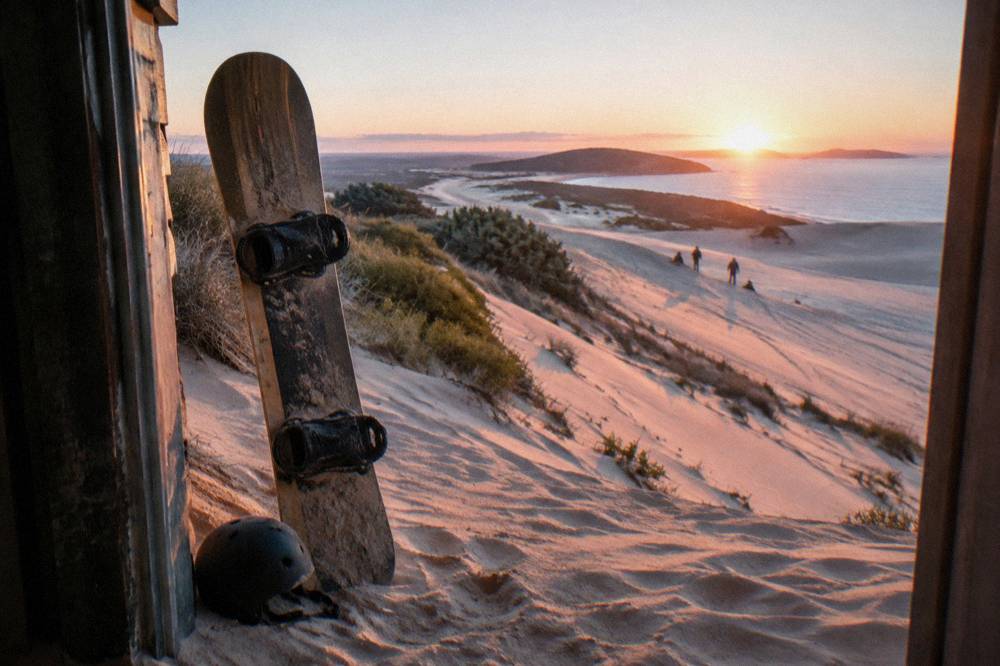
Choose the sit-down board if you want guaranteed fun with zero learning curve, the binding-free stand-up board if you want to try riding on your feet without commitment, and the strapped stand-up board if you snowboard already. Tandem setups suit children and nervous first-timers. Book the Sand Dune Safaris listing if any stand-up option appeals, because no other Port Stephens session supplies one.
The decision is genuinely that compact, because the board range is fixed by the booking rather than made on the dune. A group of six can still split formats within one Sand Dune Safaris session, some seated, some standing, which is the strongest argument for that listing beyond its price: it is the only one where the group does not have to agree. On the sit-down-only listings, the group decision is already made, and for many groups that simplicity is a feature rather than a limitation.
Timing shapes the experience as much as the board does. Morning sessions get firmer, cooler sand and faster boards; late-afternoon sessions get softer light for photographs and the capped final hour at Port Stephens 4WD Tours. The shoulder months are the comfortable middle path, and the question of when to go has its own answer in the best time to go to the sand dunes. Whenever you go, the lands themselves stay open but can close for poor weather or fire danger, so a session is always conditional on conditions on the day.
For the practical details that sit outside the boards themselves, including how the three sandboarding sessions stack up against the quad bike and 4WD products on the same dunes, the Port Stephens Sand Dune Tours homepage comparison lays every tour side by side. The short version for this question: the board is included, the board is waxed, and the only real choice you make before the dune is whether you want to sit down or stand up while the Stockton Bight does the rest.
Common Questions About Sandboarding Boards
What Kind of Board Is Used for Sandboarding?
Three types: a sit-down board ridden like a toboggan, a stand-up board with or without bindings, and tandem boards for two riders. All are supplied by the Port Stephens operators and included in the session price, with a roughly 10 minute 4WD transfer and instruction. Only the Sand Dune Safaris listing carries the stand-up and tandem formats.
Do You Need Your Own Sandboard for the Port Stephens Tours?
No. Every sandboarding listing on the Stockton Bight dunes includes board hire in the price, along with the 4WD transfer and instruction. The boards are heavy and maintained by the operators, and bringing your own would mean carrying it across the dunes after the transfer.
Is a Sandboard the Same as a Snowboard?
It looks similar but is built differently. A sandboard uses a harder laminate base waxed for dry sand, while a snowboard uses a polyethylene base waxed for snow. Bindings are optional on sand rather than standard, and there is no lift, so every run starts with a walk up the dune.
Can You Stand Up on a Sandboard in Port Stephens?
Yes, on one listing. The Sand Dune Safaris session at Anna Bay offers stand-up boards with and without foot bindings, plus tandem stand-up options, and the operator states it is the only company in Port Stephens offering both styles. The other two sandboarding listings supply sit-down boards only.
Are Sandboards Suitable for Children?
Yes, particularly the sit-down format, which needs no balance. Children ride tandem with an adult or alone on a beginner slope, and the Sand Dune Safaris listing has children 3 and under free. The dunes include gentle slopes sized for first runs, and instruction is included on every listing.
How Do You Make a Sandboard Go Faster?
Speed comes from dry warm sand, a freshly waxed base and a steeper slope. Operators wax boards through the day, so morning sessions on dry sand run quickest. Riders control speed by slope choice and by dragging feet, and damp sand after rain slows every board down.